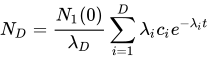
This article summarizes equations in the theory of nuclear physics and particle physics.
Definitions
| Quantity
(common name/s)
|
(Common) symbol/s
|
Defining equation
|
SI units
|
Dimension
|
| Number of atoms
|
N = Number of atoms remaining at time t
N0 = Initial number of atoms at time t = 0
ND = Number of atoms decayed at time t
|

|
dimensionless
|
dimensionless
|
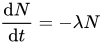
| Decay rate, activity of a radioisotope
|
A
|

|
Bq = Hz = s−1
|
[T]−1
|
| Decay constant
|
λ
|

|
Bq = Hz = s−1
|
[T]−1
|
| Half-life of a radioisotope
|
t1/2, T1/2
|
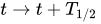
Time taken for half the number of atoms present to decay

|
s
|
[T]
|
| Number of half-lives
|
n (no standard symbol)
|

|
dimensionless
|
dimensionless
|
| Radioisotope time constant, mean lifetime of an atom before decay
|
τ (no standard symbol)
|

|
s
|
[T]
|
| Absorbed dose, total ionizing dose (total energy of radiation transferred to unit mass)
|
D can only be found experimentally
|
N/A
|
Gy = 1 J/kg (Gray)
|
[L]2[T]−2
|
| Equivalent dose
|
H
|

Q = radiation quality factor (dimensionless)
|
Sv = J kg−1 (Sievert)
|
[L]2[T]−2
|
| Effective dose
|
E
|
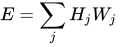
Wj = weighting factors corresponding to radiosensitivities of matter (dimensionless)

|
Sv = J kg−1 (Sievert)
|
[L]2[T]−2
|
Equations
Nuclear structure
| Physical situation
|
Nomenclature
|
Equations
|
| Mass number
|
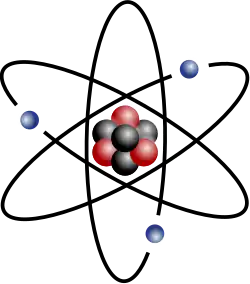
- A = (Relative) atomic mass = Mass number = Sum of protons and neutrons
- N = Number of neutrons
- Z = Atomic number = Number of protons = Number of electrons
|

|
| Mass in nuclei
|
- M'nuc = Mass of nucleus, bound nucleons
- MΣ = Sum of masses for isolated nucleons
- mp = proton rest mass
- mn = neutron rest mass
|
   
|
| Nuclear radius
|
r0 ≈ 1.2 fm
|

hence (approximately)
- nuclear volume ∝ A
- nuclear surface ∝ A2/3
|
| Nuclear binding energy, empirical curve
|
Dimensionless parameters to fit experiment:
- EB = binding energy,
- av = nuclear volume coefficient,
- as = nuclear surface coefficient,
- ac = electrostatic interaction coefficient,
- aa = symmetry/asymmetry extent coefficient for the numbers of neutrons/protons,
|
 where (due to pairing of nuclei)
- δ(N, Z) = +1 even N, even Z,
- δ(N, Z) = −1 odd N, odd Z,
- δ(N, Z) = 0 odd A
|
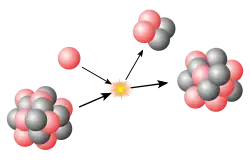
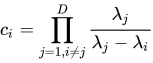
Nuclear decay
Nuclear scattering theory
The following apply for the nuclear reaction:
- a + b ↔ R → c
in the centre of mass frame, where a and b are the initial species about to collide, c is the final species, and R is the resonant state.
| Physical situation
|
Nomenclature
|
Equations
|
| Breit-Wigner formula
|
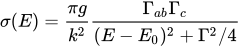
- E0 = Resonant energy
- Γ, Γab, Γc are widths of R, a + b, c respectively
- k = incoming wavenumber
- s = spin angular momenta of a and b
- J = total angular momentum of R
|
Cross-section:
Spin factor:
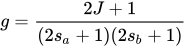
Total width:

Resonance lifetime:

|
| Born scattering
|
- r = radial distance
- μ = Scattering angle
- A = 2 (spin-0), −1 (spin-half particles)
- Δk = change in wavevector due to scattering
- V = total interaction potential
- V = total interaction potential
|
Differential cross-section:

|
| Mott scattering
|
- χ = reduced mass of a and b
- v = incoming velocity
|
Differential cross-section (for identical particles in a coulomb potential, in centre of mass frame):
![{\displaystyle {\frac {d\sigma }{d\Omega }}=\left({\frac {\alpha }{4E}}\right)\left[\csc ^{4}{\frac {\chi }{2}}+\sec ^{4}{\frac {\chi }{2}}+{\frac {A\cos \left({\frac {\alpha }{\hbar \nu }}\ln \tan ^{2}{\frac {\chi }{2}}\right)}{\sin ^{2}{\frac {\chi }{2}}\cos {\frac {\chi }{2}}}}\right]^{2}}](./_assets_/0039aaab8e6cc5e9699a9193cf602022b7ddb472.svg)
Scattering potential energy (α = constant):

|
| Rutherford scattering
|
|
Differential cross-section (non-identical particles in a coulomb potential):

|
Fundamental forces
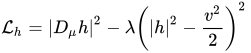
These equations need to be refined such that the notation is defined as has been done for the previous sets of equations.
| Name
|
Equations
|
| Strong force
|

|
| Electroweak interaction
|

|
| Quantum electrodynamics
|

|
See also
Sources
- B. R. Martin, G.Shaw (3 December 2008). Particle Physics (3rd ed.). Manchester Physics Series, John Wiley & Sons. ISBN 978-0-470-03294-7.
- D. McMahon (2008). Quantum Field Theory. Mc Graw Hill (USA). ISBN 978-0-07-154382-8.
- P.M. Whelan, M.J. Hodgeson (1978). Essential Principles of Physics (2nd ed.). John Murray. ISBN 0-7195-3382-1.
- G. Woan (2010). The Cambridge Handbook of Physics Formulas. Cambridge University Press. ISBN 978-0-521-57507-2.
- A. Halpern (1988). 3000 Solved Problems in Physics, Schaum Series. Mc Graw Hill. ISBN 978-0-07-025734-4.
- R.G. Lerner, G.L. Trigg (2005). Encyclopaedia of Physics (2nd ed.). VHC Publishers, Hans Warlimont, Springer. pp. 12–13. ISBN 978-0-07-025734-4.
- C.B. Parker (1994). McGraw Hill Encyclopaedia of Physics (2nd ed.). McGraw Hill. ISBN 0-07-051400-3.
- P.A. Tipler, G. Mosca (2008). Physics for Scientists and Engineers: With Modern Physics (6th ed.). W.H. Freeman and Co. ISBN 978-1-4292-0265-7.
- J.R. Forshaw, A.G. Smith (2009). Dynamics and Relativity. Wiley. ISBN 978-0-470-01460-8.
Further reading
- L.H. Greenberg (1978). Physics with Modern Applications. Holt-Saunders International W.B. Saunders and Co. ISBN 0-7216-4247-0.
- J.B. Marion, W.F. Hornyak (1984). Principles of Physics. Holt-Saunders International Saunders College. ISBN 4-8337-0195-2.
- A. Beiser (1987). Concepts of Modern Physics (4th ed.). McGraw-Hill (International). ISBN 0-07-100144-1.
- H.D. Young, R.A. Freedman (2008). University Physics – With Modern Physics (12th ed.). Addison-Wesley (Pearson International). ISBN 978-0-321-50130-1.