Gelli Farmhouse, Llanvetherine
| Gelli Farmhouse | |
|---|---|
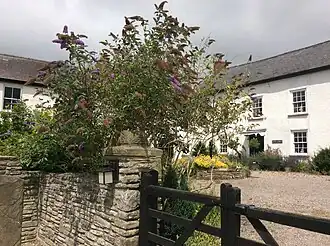 "an exceptionally well-preserved early 17th century interior" | |
| Type | House |
| Location | Llanvetherine, Monmouthshire |
| Coordinates | 51°50′50″N 2°55′45″W / 51.8473°N 2.9293°W |
| Built | 17th century |
| Architectural style(s) | Vernacular |
| Governing body | Privately owned |
Listed Building – Grade II* | |
| Official name | Gelli including attached cider house, farm range and barn |
| Designated | 19 October 2000 |
| Reference no. | 24196 |
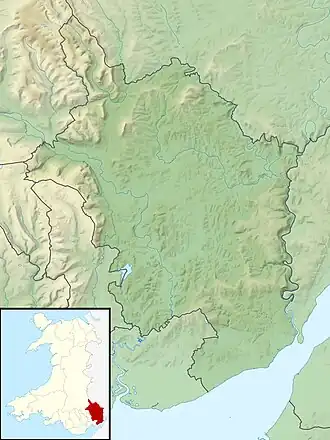  Location of Gelli Farmhouse in Monmouthshire | |
Gelli Farmhouse, Llanvetherine, Monmouthshire, is a farmhouse dating from the early 17th century. The settlement at Gelli-wig has a recorded history dating from the 14th century. The house is Grade II* listed.
History
The manor of Gelli-wig is recorded as belonging to Roger de Gunter in 1349.[1] Cadw considers that the current house is likely to have been built by James Hughes, in the early to mid-17th century. Hughes's descendant, also James, was Sheriff of Monmouthshire in 1717 and was probably responsible for the 18th century reconstruction.[1] Later in that century, the house was the vicarage for the Reverend William Watkins, vicar of Llangattock Lingoed, Llantilio Pertholey and Llanvihangel Crucorney.[1] The farmhouse remains a private residence.
Architecture and description
The house was originally two residences, set at right angles.[1] The left-hand block has a cider house attached to it.[1] The house is of sandstone rubble, now rendered, of two storeys and with a slate roof.[1] The interior is "exceptionally well-preserved"[1] and contains important decorative features from the 17th and 18th centuries, including a "highly unusual painted" parlour.[1] Fox and Raglan also note a "good fireplace" in the Renaissance style of their three-volume series Monmouthshire Houses.[2]
The farmhouse is a Grade II* listed building.[1]
Notes
References
- Fox, Cyril; Raglan, Lord (1994). Part III, Renaissance Houses. Monmouthshire Houses. Cardiff: Merton Priory Press Ltd & The National Museum of Wales. ISBN 1-898937-00-1. OCLC 896061774.